Posts

Showing posts with the label OAS
Get new posts by email:
  

What Does Generation Squeeze Have Against Couples?

An organization called Generation Squeeze is calling for big cuts to Old Age Security (OAS) .  For some reason, these cuts are aimed exclusively at senior couples.  Digging into the numbers, the proposal makes no sense. The stated goal of the proposed OAS changes is to free up government money for other priorities.  Whether or not OAS is the right target for reducing government spending is a different discussion.  The puzzling part of this proposal is having all the cuts apply to senior couples. Currently, OAS will get clawed back from any senior whose 2025 net income (Line 23400 of the tax return) is over $93,454.  For each dollar over this income threshold, OAS payments are reduced by 15 cents.  The current rules make no distinction between singles and couples.  The calculation is based on each person’s own income without regard to whether they have a spouse. Generation Squeeze wants to change the threshold to $100,000 for total household income....

<< Previous Post

The Case for Delaying CPP and OAS

Image
I was a guest on a TD Direct Investing webinar to discuss the case for delaying the start of CPP and OAS payments with Robert Moysey.  He did a great job asking good questions and keeping me on track.  See the link to the video below.  

<< Previous Post

Old Man Yells at Clouds on Podcast about CPP and OAS

Image
In a weak moment, I agreed to appear on a podcast.  I like podcasts, but I’m not trying to build my brand or anything like that, so my sole motivation is to help others.  This can be a weak motivator in the face of doing actual work. But Robert Moysey asked me many good questions about CPP and OAS, and I’ll be appearing on his investing webinar series on Thursday, May 29th at 2:00 pm. For those with average health and who have enough money to live on through their 60s, it makes sense to consider waiting until age 70 to start collecting CPP and possibly OAS too. Here are the particulars for those interested in watching: DATE : Thursday, May 29, 2025 @ 2 PM ET TITLE : Is it a mistake to take CPP and OAS early? DESCRIPTION : Some retirees like to take Canada Pension Plan (CPP) and Old Age Security (OAS) payments as soon as they're eligible for them in hopes of maximizing the value they draw from those programs. Are they making a massive mistake that could cost them dearly in reti...

<< Previous Post

The Case for Delaying OAS Payments has Improved

Image
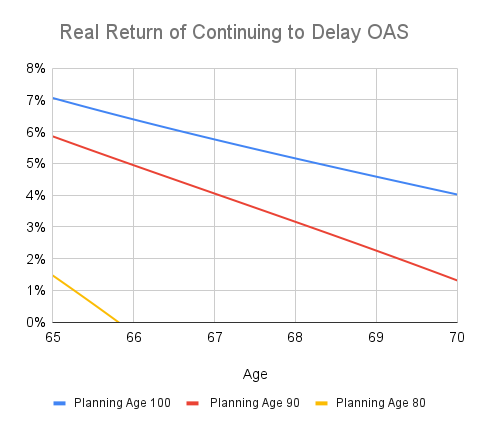
Canadians who collect Old Age Security (OAS) now get a 10% increase in benefits when they reach age 75.  The amount of the increase isn’t huge, but it’s better than nothing.  A side effect of this increase is that it makes delaying OAS benefits past age 65 a little more compelling. The standard age for starting OAS benefits is 65, but you can delay them for up to 5 years in return for a 0.6% increase in benefits for each month you delay.  So, the maximum increase is 36% if you take OAS at 70. A strategy some retirees use when it comes to the Canada Pension Plan (CPP) and OAS is to take them as early as possible and invest the money.  They hope to outperform the CPP and OAS increases they would get if they delayed starting their benefits.  In a previous post I looked at how well their investments would have to perform for this strategy to win .  Here I update the OAS analysis to take into account the 10% OAS increase at age 75. This analysis is only relevant...

<< Previous Post

How Much Savings Do You Need to Delay Starting CPP and OAS Pensions?

Canadians who take their CPP at age 60 instead of 70 “can expect to lose over $100,000 of secure lifetime income, in today's dollars, over the course of their retirement,” according to Dr. Bonnie-Jeanne MacDonald in research released by the National Institute on Ageing (NIA) and the FP Canada Research Foundation .  However, those who retire before 70 need savings to tide them over until their larger CPP pensions start if they want to live at least as well in their 60s as they do later in retirement.  Here we look at the amount of savings required by a retired 60-year old to be able to delay CPP and OAS pensions. We’re used to thinking of CPP and OAS pensions as just a few hundred dollars per month, but a 70-year old couple just starting to receive maximum CPP and OAS pensions (but not any of the new expanded CPP) would get $61,100 per year, rising with inflation for the rest of their lives.  If the same couple were 65 they’d only get $43,700 per year.  If this 65-yea...

<< Previous Post

Another Emotional Reason to Take CPP Early

For some reason, people seem wired to want to take their CPP and OAS benefits early, myself included. They grasp for reasons to justify this emotional need even though a rational evaluation of the facts often points to delaying the start of these pensions to get larger payments. I recently read about another emotional reason to justify taking CPP and OAS early. We can choose to start taking CPP anywhere from age 60 to 70, but the longer we wait, the higher the payments. Less well known is that we can start taking OAS anywhere from age 65 to 70 with higher payments for waiting loger. It’s hard for us to fight the strong desire to take the money as soon as possible, and we tend to latch onto good-sounding reasons to take these pensions early. But the truth is that most of us have to plan to make our money last in case we live long lives. Taking CPP and OAS early would give us a head start, but the much-higher payments we’d get starting at age 70 allow us to catch up quickly. If...

<< Previous Post

CPP and OAS Breakeven Ages

The default age to start collecting CPP and OAS is 65, but Canadians are allowed to defer these pensions until they’re 70 in return for permanently higher payments. The internet is filled with analyses of how old you have to live to come out ahead by delaying benefits. The mistake people make is in how they use these “breakeven” ages. Suppose you work out that your CPP breakeven age is 85. If you don’t live that long, you’ll get more if you take CPP early, and if you live longer, you’ll get more by delaying CPP to age 70. There are many factors that feed into calculating a breakeven age, including how aggressively you invest, but let’s just use age 85 as an example. Worrying about the breakeven age only makes sense if you have enough savings to live on until at least age 70 without one or both of CPP and OAS. If you don’t have enough savings, you have little choice but to start taking government pensions before your savings run out. We’ll assume that you do have enough savin...

<< Previous Post

The Value of Delaying CPP and OAS

Few people realize that you can delay receiving CPP and OAS until age 70 in return for permanently higher payments. Among those who know this is an option, very few choose to wait. I went through the exercise of calculating my safe level of annual spending when taking CPP and OAS at different ages and found that I can start spending more today if my wife and I wait until age 70 for our pensions. You can start CPP anywhere from age 60 to 70, and OAS can start anywhere from 65 to 70. I created a spreadsheet that calculates our CPP and OAS payments for chosen starting ages of these pensions. Then the spreadsheet calculates our estimated safe annual spending level throughout retirement. Consider two scenarios: Scenario 1: We both take CPP at 60 and OAS at 65 Scenario 2: We both take CPP and OAS at age 70 In both scenarios, we’re both retired now with no expectations of earning income in the future. The results were that Scenario 2 allows us to spend $3920 more per year (start...

<< Previous Post

Should You Delay Taking CPP and OAS?

Image
The default age to start collecting Canada Pension Plan (CPP) payments is 65. However, you can start anywhere from age 60 to 70. Less well known is that you can delay collecting Old Age Security (OAS) payments until age 70 as well. There are incentives for delaying these payments, and it’s not easy to decide whether to take lower payments early or wait for larger payments. Here I do an analysis that helped me make up my mind. OAS Let’s start with OAS because it’s simpler. The default starting age is 65. However, your payments increase by 0.6% for each month you delay starting to take OAS before age 70. So, if you wait until age 70, you’ll get $1.36 for every dollar you would have received when starting at 65. It’s important to understand that these amounts are indexed to inflation. Some people mistakenly believe that someone starting to collect at age 65 would have his payments catch up to the amounts received by someone taking OAS at age 70. This is not true. Consider...

<< Previous Post

The Case for Delaying CPP and OAS to Age 70

There are good reasons why some people start collecting CPP and OAS benefits as early as possible. However, many people start collecting CPP and OAS early for emotional reasons that don’t hold up under scrutiny. The main reason to delay benefits until age 70 is simple enough: most of us need to plan for the possibility of a long life. Let’s start with some basics about CPP and OAS payments. Old Age Security (OAS) can start anywhere from age 65 to 70. Most Canadians at age 65 are eligible for the maximum pension (currently $578.53/month and rising with inflation). However, waiting until age 70 gives the payments a 36% boost (0.6% for each month of delay). A 70-year old just starting OAS today would get $786.80/month. Canada Pension Plan (CPP) benefits are more complex to calculate. Doug Runchey has a great description of how to calculate your CPP pension . The biggest CPP retirement pension a 65-year old can collect today is $1114.17/month, rising with inflation. However, t...

<< Previous Post

Personal Finance Election Issues

Recently, Mark Seed at My Own Advisor called on Canadians to turn three personal finance issues into election issues . It certainly makes sense to take personal finance policies into account when you vote. Unfortunately, I mostly disagree with Mark on all three of his points. Here are Mark’s preferences in bold followed by my thoughts. 1. Keep the Tax Free Savings Account (TFSA) contribution limit at $10,000. On the surface, the choice is between a $5500 TFSA limit and a $10,000 limit. But that misses a crucial point. When the government increased the limit, they eliminated inflation indexing. So, the real choice is between $5500 with automatic cost-of-living increases or a fixed $10,000 limit whose value declines each year with inflation. It can be difficult to imagine that $10,000 will become a much less valuable amount of money at some point in the future, but it will happen. Just 5 or 6 decades ago, $10,000 could buy a nice house. Now it’s not much of a used car. F...

<< Previous Post

OAS Age Change Debate

To say that some people are unhappy that eligibility for Old Age security (OAS) will be going up from age 65 to 67 is an understatement. Preet Banerjee collected together some of the more reasoned arguments in this debate. I don’t want to pick on Preet because he’s definitely one of the good guys, but I don’t agree with everything he said. My main concern is with the oft-quoted statistic that OAS and GIS (Guaranteed Income Supplement) payments are currently 2.36% of GDP and are expected to rise to 3.14% of GDP by 2030. Preet says that some see this as a “whopping” increase, it doesn’t really look very whopping at all. I disagree. GDP (Gross Domestic Product) is the market value of everything produced in the entire country. Just about anything you measure as a percent of GDP (except government debt) is going to look small. Even Bernie Madoff’s fraud was only 0.45% of U.S. yearly GDP. If my cable company tried to convince me to take a full suite of all their top-of-the-line se...

<< Previous Post

OAS Remedies Should Not Be Just about Cost Containment

In a recent article, Rob Carrick suggested increasing the tax clawback for Old Age Security (OAS) as a way to control costs. This would have the effect of lowering benefits without having to increase the retirement age. However, I think we need to have goals other than just cost containment. Life expectancy has risen considerably since 65 was chosen as a retirement age. Instead of increasing the retirement age as life expectancy rises, government workers tend to retire in their late 50s, with many retiring at age 55. Many of these workers will be retired as long as they were working. This is not sustainable. Outside of powerful unions in the public and private sectors, pensions are generally dismal by comparison. Many advocate an improved pension system for all that is as strong as the pensions that government workers enjoy. This will never happen. How could we possibly run a country if nearly half of all adults are retired? Who would mow the lawns on the golf courses? W...

<< Previous Post

Boomers Get a Good Deal with CPP

In a recent post, I showed that under current rules, baby boomers will get more from Old Age Security (OAS) than they contributed through their incomes taxes . I expected to get angry comments from boomers who don’t like the idea of changing OAS. Instead, several readers observed that boomers will get more from CPP than they paid in as well. Robert Hurdman pointed out that CPP is not fully funded which means that retirees get some of their benefits from current CPP contributions. Fortunately, the situation is improving as the degree of funding increases each year. This should reduce future inequities. Reader Greg put together a CPP spreadsheet analysis concluding that the oldest baby boomers will collect about twice as much as they paid into CPP. Changes to CPP contribution rates between 1986 and 2003 have made CPP less of a good deal for younger baby boomers. Greg’s second spreadsheet summarizes results for different birth years. Here is Greg’s summary of the spreadsheet ...

<< Previous Post

Tax Fairness would Decimate Old Age Security

In a CBC interview about pension reform, Susan Eng of CARP was discussing the taxes baby boomers have paid to support old age security (OAS) payments: “These are the same people who paid their taxes all through their working lives and have funded their retirement in this way.” So, she is saying that it is an issue of tax fairness; boomers paid for their OAS benefits and would be cheated if these payments were reduced. Unfortunately, if we really introduced tax fairness it would decimate OAS. The reason for this is a combination of the way OAS is funded and demographics. Unlike CPP, OAS is paid from current tax revenues. While the CPP amounts deducted from our pay are saved to cover future CPP benefits, OAS payments to retirees are paid for by current taxpayers. This means that boomers paid for their parents’ OAS and they will collect OAS payments from their children. Boomers were in the middle of their careers around the year 2000. They will be in the middle of their retirem...

<< Previous Post

Secondary Effects of TFSAs

According to Newton, for every action there is an equal and opposite reaction. If the proposed Tax-Free Savings Account (TFSA) becomes law in Canada, we should expect reactions to the changes it will cause. The main factor that determines whether TFSAs or RRSPs are better is tax rates . If your tax rate will be higher when you withdraw money than it was when you contributed money, then you should prefer a TFSA. Ironically, it is often the poorest seniors who fall into this category because of clawbacks. As a senior’s income rises, the Guaranteed Incomes Supplement (GIS), the age credit, and Old Age Security (OAS) all get clawed back, which can make the effective tax rate very high. For example, a senior with an income of $12,000 who withdraws an extra $1000 from an RRSP or RRIF will pay an extra $780 in income taxes, mainly because of the GIS clawback. This is a tax rate of 78%. Effective tax rates can be even higher due to other government programs with income tests. Having a hi...

<< Previous Post

Archive

Show more