Posts

Showing posts with the label spending
Get new posts by email:
  

Book Review: The Art of Spending Money

Whether you agree or disagree with his arguments, Morgan Housel tells entertaining stories, and his latest book, The Art of Spending Money: Simple Choices for a Richer Life is no exception.  What I liked most about this book is it caused me to think.  Mostly, I agreed.  Occasionally I disagreed.  Sometimes I recognized my own ideas, and sometimes I had something new to ponder.  The book flew by. Most people I know will find that the way they think about spending aligns well with Housel’s recommendations.  The readers who will likely benefit the most are those who give up too much of what matters in their lives to amass wealth.  Such wealth builders are the type of person the financial industry seeks out, and it’s not surprising that writers from the financial industry tend to write for this type of person.  These writers often exaggerate how common it is for the general population to have their type of money obsession.  We all tend to speak ...
<< Previous Post

Bad Retirement Spending Plans

A recent research paper by Chen and Munnell from Boston College asks the important question “ Do Retirees Want Constant, Increasing, or Decreasing Consumption? ”.  The accepted wisdom until recently was that retirees naturally want to spend less as they age.  This new research challenges this conclusion. What we all agree on is that the average retiree spends less each year (adjusted for inflation) over the course of retirement.  However, averages can hide a lot of information.  The debate is whether this decreasing spending is voluntary or not.  However, it’s important to recognize that the answer is different for each retiree.  Some don’t spend less over time, some spend less voluntarily, and some are forced to spend less as their savings dwindle. I’ve been saying for some time that not all spending reductions by retirees are voluntary and that this affects the average spending levels across all retirees.  I’ve discussed this subject with many people...

<< Previous Post

Searching for a Safe Withdrawal Rate: the Effect of Sampling Block Size

Image
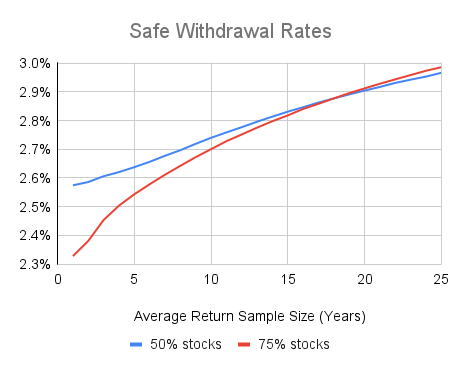
How much can we spend from a portfolio each year in retirement?  An early answer to this question came from William Bengen and became known as the 4% rule .  Recently, Ben Felix reported on research showing that it’s more sensible to use a 2.7% rule .  Here, I examine how a seemingly minor detail, the size of the sampling blocks of stock and bond returns, affects the final conclusion of the safe withdrawal percentage.  It turns out to make a significant difference.  In my usual style, I will try to make my explanations understandable to non-specialists. The research Bengen’s original 4% rule was based on U.S. stock and bond returns for Americans retiring between 1926 and 1976.  He determined that if these hypothetical retirees invested 50-75% in stocks and the rest in bonds, they could spend 4% of their portfolios in their first year of retirement and increase this dollar amount with inflation each year, and they wouldn’t run out of money within 30 years. R...

<< Previous Post

Compensating for Your Money Personality

When my wife and I were young, we were very frugal. I recall walking around for over a month with the same ten-dollar bill in my pocket. We’re less frugal now but still having a hard time transitioning from workers who save to retirees who spend. Fortunately, we’ve found some ways to compensate for the aspects of our money personalities that aren’t helping us any more. In my case, I fuss over spreadsheets that show we consistently underspend our safe monthly allowance. This gives me constant reminders that I’m no longer an 18-year old kid who doesn’t have enough money to eat lunch. In my wife’s case, she feels the pain of every expenditure. This is particularly true if the expense seems extravagant, like eating out. To compensate for this, I pay in almost all situations where we’re together. This wasn’t a revelation of mine; my wife knows herself well enough that she’s the one who wants me to pay. In fact, I might not even have noticed this pattern if she hadn’t pointed it...

<< Previous Post

Emotional Money Choices

My wife and I are savers, and I like to think we make mostly rational financial choices. But there are a few less than rational things we do with money that make us happier. I’m not saying it’s irrational to seek happiness, but the reasons for these choices are definitely on the emotional side. Over-saving for retirement We saved quite a bit more than we needed to retire to the life we want. We could have quit our jobs earlier, but nagging doubts about whether we had enough drove us to work longer. It’s quite reasonable to save some extra as a buffer, particularly if you have a high-paying job and you’d make much less trying to re-enter the workforce years later. However, we went well beyond a reasonable safety buffer. But if we hadn’t over-saved, we would have felt uncomfortable, and we likely would have reduced spending on pleasures like travel. So, given our conservative financial natures, I think we made the right choice, even if it is somewhat emotional. Large saving...

<< Previous Post

10 Ways to Stay Broke Forever

One starting point for improving your personal finances is to look at what doesn’t work. This is the approach Laura J. McDonald and Susan L. Misner take in their book 10 Ways to Stay Broke Forever . The authors offer many suggestions for changing negative spending habits, but the book also contains a number of parts that make me question the authors’ numeracy. Financial education “tends to be technical, overly complex and written in obscure, jargon-filled prose. As a result, it often fails to reach the very people for whom it is designed.” This book is quite easy to read. However, some attempts to lighten the subject matter seem forced, such as starting an explanation of liquid assets with “This always makes us think of the bottle of Patrón Gold tequila stashed in our freezer.” Positive aspects of the book include discussions about cars. Rather than leasing, if you save up before you need a car “you could go buy that sweet ride outright, with cash .” Another section has some...

<< Previous Post

High Housing Costs vs. Avocado Toast

By now just about everyone has heard how wealthy Australian Tim Gurner admonished young people for wasting money on avocado toast while they complain about high housing costs. This has led to a predictable backlash. It seems that avocado toast is easy to mock. As is usually the case, neither side of this “debate” is entirely right or wrong. It’s tough that rents and house prices are so high today. No matter how frugal people are in all other areas of spending, rents and mortgages are still painfully expensive. But wasting money in other areas doesn’t help. David Chilton once wrote that people most underestimate the costs of “(1) cars; (2) dining out; and (3) little things.” Rather than literally discussing avocado toast, we should look at it as a stand-in for “little things.” The cost of little things adds up quickly. Most of us have little idea how much we spend on our habits. For most of us it’s easily hundreds of dollars per month. I’d be willing to bet that if most p...

<< Previous Post

Excuses to Shop

My wife received some credit card spam that started as follows: “The year is almost over, but you can still build your January rebate! Use your [brand of credit card] to earn cash back on special gifts, last-minute holiday purchases and everything in between.” She laughed and showed it to me. My first thought was who would spend an extra $1000 now just to get $20 more back in January? Most people aren’t great at math but they’re not this bad. This message seems like it shouldn’t work on anyone. But credit card marketers can’t be this dumb. There has to be more to this than I saw at first. One possibility is they are aiming this message at people with multiple credit cards in an attempt to get them to use this particular card more often for things they were going to buy anyway. But I think there is a better explanation. I think this message is mainly aimed at shopaholics. Addicts will latch onto any excuse to scratch their itch. Compulsive shoppers need an excuse to shop ...

<< Previous Post

How Much Do You Need to Save to Retire?

Just poke around the internet for a while looking for answers to how much money you need to save before you retire and you’ll get answers ranging from next to nothing up to $3 million or more. It looks like some of them must be wrong, but it all comes down to your spending and pensions. Let’s take an example. A Canadian couple, Mary and Bill, are both 65, have no debts, have no workplace pension, and are about to retire. They both worked enough to get maximum CPP benefits. Together they can expect CPP plus OAS of $3200 per month rising with inflation. Suppose that $3200 is enough to cover their spending. Then the total savings they need is zero. Nada. Zilch. It can be dangerous to count on being able to work until age 65, to count on maximum CPP benefits, and to assume you can live on $3200 per month, but now that Mary and Bill have made it to 65, they need no savings beyond a modest emergency fund. What happens if Mary and Bill have a more expensive lifestyle? Let’s say...

<< Previous Post

Retirement Spending Stages

It’s definitely true that most people’s retirement spending declines as they age. Financial Planners tell a story of how this reduction in spending is natural and that you should plan for it in your own retirement. Here I tell a different story that leads to a different conclusion. Certified Financial Planner Roger Whitney captured the usual story of the three stages of retirement clearly: “In the ‘go go’ years of retirement, your spending may be at its peak. This is the time for travel, activities, adventures and family. In the ‘slow go’ years, your spending may slow as you become more settled. In the ‘no go’ years, you may spend even less as you settle in even more.” This sounds so logical that it’s easy to accept the advice to spend a lot in your early retirement years. But let’s analyze this a little further. Let’s call these stages, the 60s, 70s, and 80s. Will you really want to start cutting spending when you’re only 70? It’s true that, on average, people do begi...

<< Previous Post

Typical Spending vs. Average Spending

Image
The gap between your typical monthly spending and your average monthly spending is what gets many people into financial trouble. I collected my family’s monthly spending since 2010 to illustrate how it’s human nature to get into financial trouble if you’re not wary. My family’s monthly spending is shown in the chart below. I’ve omitted the grid-lines for privacy reasons and because the absolute dollar numbers aren’t important to the points I’m making. (You may wonder about that very low month near the middle of the chart. In cases where I made a purchase and was reimbursed, I treated the reimbursement as a negative amount spent. That month my employer reimbursed me for travel expenses I had in the previous couple of months.) The main thing to see with this chart is the amount of variation from month to month. My family’s spending variation may be greater than most, but everybody’s spending varies somewhat. Some people are dedicated to using equal billing plans and paying f...

<< Previous Post

Who Owns the Money in a Relationship?

My wife and I have various assets such as our home and our savings. The question of who owns what can be surprisingly complex. The reason for this complexity is that there are three different points of view on answering this question. Here I look at our assets from each of these points of view. How We See Ownership Our view of ownership is quite simple: 50/50 for everything. I know that some couples choose to have his and hers money, but that’s not how we do it. When it comes to paying for things, we decide who will pay based on convenience. If my wife needs some cash, I hand her some without bothering to do any kind of accounting. I think this works well for us because we are both quite frugal. Control of Assets Just because the ownership of our assets is 50/50 doesn’t mean that we each exercise 50% control of all assets. To pick a trivial example, I don’t touch her toothbrush. It might be 50% mine in an ownership sense, but in terms of control it’s 100% hers. This ...

<< Previous Post

Telling Us What We Want to Hear about Our Retirement Magic Numbers

Wouldn’t it be great if we didn’t need to save so much money to have a great retirement? Well, if you don’t look too closely, David Blanchett, Head of Research at Morningstar Investment Management, can help with his paper Estimating the True Cost of Retirement . Blanchett’s paper is very clearly written making it quite easy to follow his logic: 1. Most studies of safe retirement spending levels assume that spending increases by inflation each year (i.e., flat spending in real terms). 2. Thorough research of real spending data shows that retirees’ spending, on average, does not increase by the full amount of inflation each year. 3. A typical conclusion based on flat spending is that the maximum safe withdrawal rate is 4% at the start of retirement. 4. Using the actual spending curve for the age range 60-95, the safe withdrawal rate at the start of retirement is closer to 5%. Isn’t this great news? If you thought you needed $2 million to retire well, Blanchett says you only ...

<< Previous Post

Working Out Your Retirement Magic Number

How much money do you need to save to retire? This is an important question that gets a lot of debate but few useful answers. We hear arguments over whether a million dollars is enough, as though there is a single number that applies to everyone. Here I offer an answer based on a proposed retirement spending strategy that takes into account your unique circumstances. Lately, I’ve been writing a fair bit about a proposed strategy for retirement spending in retirement ( first description , adding income smoothing , yearly spending percentages , experimental results using 100 years of investment returns ). The focus was on turning a lump-sum portfolio into an income stream for retirement. But we can turn this around and calculate how much you need to save to retire using this spending strategy. I added another page to the spreadsheet that computes the percentage of a portfolio that you can spend each year in retirement based on a set of inputs you supply. (To edit this spreadsh...

<< Previous Post

Retirement Spending Experiment

Image
I decided to run an experiment to test a retirement spending strategy ( described here ) on actual stock returns over the past 100 years. The goal of the experiment is to see how well the spending strategy balances the need for stable income against the need to adapt spending to portfolio gains and losses. Along with the retirement spending strategy , I gave a spreadsheet to calculate the yearly spending amounts. My experiments used the default values in the spreadsheet (a 4% real return on an all-stock portfolio, low investment costs, target longevity of 100, and 5 years of spending kept in safe investments, among other assumptions). I used inflation-adjusted stock returns in the U.S. from 1913 to the present to simulate seventy 30-year portfolios for an investor retiring at age 60. The spreadsheet calculations set yearly retirement spending for a 60-year old at 4.17% of total retirement savings. This percentage rises to 9.74% by age 89. I chose a starting portfolio value...

<< Previous Post

Treating Your Entire Portfolio like a RRIF in Retirement

Tax rules for RRIFs require you to withdraw a percentage each year that depends on your age. One thought for choosing how much to spend from your entire portfolio in retirement is to use the same table of RRIF percentages.  This idea makes sense to me, but I chose to work out my own percentages. A while back I proposed a possible retirement income strategy where you set aside a fixed number of years of spending somewhere safe (like a high-interest savings account (HISA)) and invest the rest of your savings with the same portfolio allocations you had before retirement. The strategy calls for using your current portfolio balance to choose a spending level. To determine the amount you can spend, you would assume a fixed investment return and calculate the yearly spending level that would deplete the portfolio by some fixed age. Then if your portfolio either gets higher or lower returns than expected, your spending level would increase or decrease. The HISA savings serve to sm...

<< Previous Post

Seeking a Rational Explanation for Spending

Perhaps I’ve been too hasty suggesting that people who spend too much are being foolish. Sometimes when I see people doing things that make no sense, I’ve later realized that I just misjudged their goals. Coaching and playing baseball and softball, I’ve seen plenty of players who ignore bunt signs and others who swing away on 3-0 pitches. I used to think that the remedy was to explain to them that their actions are reducing our team’s chances of winning. Sometimes this works, but often it doesn’t because some players don’t care much whether the team wins. They like hitting home runs and their actions are quite sensible once you understand that their goal is not team victory. Similarly, when I was young and naive, I would see the CEOs of the companies I worked for do things that were detrimental to the long-term health of the company. I thought maybe I was missing something or that the CEOs were misguided. Much later I realized that these CEOs were maximizing the near-term val...

<< Previous Post

Split Spending Personality

I’m often struck by the extreme difference between the cost of my business travel and the cost of my personal traveling choices. It’s not just the cost that is different; my attitudes about what types of accommodations, flights, and meals are acceptable differs depending on whether my travel is personal or business. It’s as though I have a split personality. As examples of costs, the airfare of my last two business trips adds up to about $11,700, but the total cost of my last vacation (of 8 days) was $1200 including food, golf, accommodations, and airfare. As an example of attitudes, I’m content to sleep on a bunk-bed and eat burnt toast when I’m on a personal golf trip, but I find myself critical of small things at hotels when on business travel such as inefficient handling of my luggage or poor timing of maid service. I’d be interested in knowing how common it is for people to have very different spending personalities in different contexts.

<< Previous Post

Archive

Show more