Posts

Get new posts by email:
  

Bad Retirement Spending Plans

A recent research paper by Chen and Munnell from Boston College asks the important question “ Do Retirees Want Constant, Increasing, or Decreasing Consumption? ”.  The accepted wisdom until recently was that retirees naturally want to spend less as they age.  This new research challenges this conclusion. What we all agree on is that the average retiree spends less each year (adjusted for inflation) over the course of retirement.  However, averages can hide a lot of information.  The debate is whether this decreasing spending is voluntary or not.  However, it’s important to recognize that the answer is different for each retiree.  Some don’t spend less over time, some spend less voluntarily, and some are forced to spend less as their savings dwindle. I’ve been saying for some time that not all spending reductions by retirees are voluntary and that this affects the average spending levels across all retirees.  I’ve discussed this subject with many people...
<< Previous Post Next Post >>

Short Takes: Too Many Accounts, the Advice Gap, and more

I prefer to have as few bank accounts and investment accounts as possible.  However, there are RRSPs, TFSAs, non-registered accounts, and Canadian and U.S. dollars that drive me to open ever more accounts.  The latest reason I had to open a new account seems the silliest to me.  I have a U.S. dollar chequing account as part of an InvestorLine account.  It behaves like any other BMO U.S. dollar chequing account except that I can’t do a global money transfer from it.  So, I had to open a “normal” U.S. chequing account at a BMO branch.  So, now when I want to send money to the U.S., I have to move money from InvestorLine to my new “regular” U.S. dollar chequing account, and then from there to the U.S.  When I opened this new account, the bank employee asked what name I’d like to give it.  I was tempted to say “stupid,” but I settled on “USD.” Here are some short takes and some weekend reading: Jason Pereira has a strong take on the supposed financia...

<< Previous Post Next Post >>

Short Takes: InvestorLine’s HISAs, 24-Hour Trading, and more

I recently moved some cash into BMO InvestorLine’s high-interest savings accounts (HISAs) that are structured as mutual funds.  Their designations are BMT104, BMT109, and BMT114, and they purportedly pay 4.35% annual interest (which they can change whenever they like).  However, the way they report the monthly interest payments is so baffling that I wasn’t able to sort it out in my first 15 minutes of trying.  A further complication is the following text in the HISA description: “The Bank may pay, monthly or quarterly, compensation to your Dealer at an annual rate of up to 0.25% of the daily closing balance in the BMO HISA.”  I couldn’t find any evidence of such a charge, but I haven’t been invested for a full quarter, and I can’t yet say that such a charge isn’t buried somehow in the confusing reporting.  I have more digging to do before I can recommend these HISAs. Here are some short takes and some weekend reading: Preet Banerjee explains the dangers of Robi...

<< Previous Post Next Post >>

Short Takes: Loosening up on Spending, What Advisors Know, and more

My most recent post is: Finding a Financial Advisor Here are some short takes and some weekend reading: Mr. Money Mustache has decided that he has become too frugal and needs to loosen up.  He’s not alone.  I know many people who spend way below their means, although they are greatly outnumbered by overspenders.  I’ve been told by high-end financial advisors that a high proportion of their clients are underspenders, but that’s an extreme example of survivorship bias.  Underspenders need to learn to spend a little in ways that will make them and others they care about happy.  Sadly, because people tend to embrace arguments they already believe, Mr. Money Mustache’s article is likely to resonate with overspenders more than it reaches underspenders.  Given the reach of his blog hopefully he’ll help a few people with these ideas. Tom Bradley explains the many things that nobody knows, but people think financial advisors do know.  He goes on to explain th...

<< Previous Post Next Post >>

Finding a Financial Advisor

After reading yet another article on how to find a good financial advisor, I was struck by how useless the advice is for most people.  The problem is that how you should proceed depends on your income and net worth.  There is no one-size-fits-all solution. Let’s consider a couple of examples to illustrate what I mean. Case 1:   Meet Amy.  She’s in her 30s, earns $65,000 per year, and has $10,000 saved.  She’s learned that how she invests can make a big difference in how much money she will have saved by the time she retires.  She knows she needs good advice and would like to find a financial advisor.  She’s also read that it’s best to find a fiduciary. How should Amy proceed?  To start, Amy should get some hockey equipment to protect her body from all the doors that will slam in her face.  She is nowhere close to the type of client fiduciaries want. Case 2: Susan is in her early 60s, earns $800,000 per year, and has $10 million saved.  ...

<< Previous Post Next Post >>

Short Takes: Empty Return Promises, Asset Allocation ETFs, and more

I came across yet another case of a furious investor whose advisor had promised a minimum return, but the portfolio lost money.  There is a lot wrong with this picture.  On the client side, they often believe that advisors have some meaningful level of control over returns and that advisors can somehow steer around bear markets, which is nonsense.  Advisors can choose a risk level.  The only way to guarantee a (low) return is to take little or no risk.  On the advisor side, I can only assume that many advisors are under so much pressure to land clients that they make promises they know they can’t keep unless they get lucky.  All the while, the management above these advisors know full well what is going on. Here are my posts for the past four weeks: Giving With a Warm Hand The Case for Delaying OAS has Improved Here are some short takes and some weekend reading: Robb Engen at Boomer and Echo sings the praises of Vanguard Canada’s Asset Allocation ETFs....

<< Previous Post Next Post >>

The Case for Delaying OAS Payments has Improved

Image
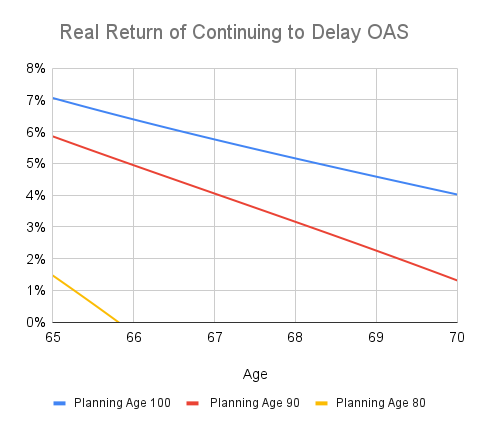
Canadians who collect Old Age Security (OAS) now get a 10% increase in benefits when they reach age 75.  The amount of the increase isn’t huge, but it’s better than nothing.  A side effect of this increase is that it makes delaying OAS benefits past age 65 a little more compelling. The standard age for starting OAS benefits is 65, but you can delay them for up to 5 years in return for a 0.6% increase in benefits for each month you delay.  So, the maximum increase is 36% if you take OAS at 70. A strategy some retirees use when it comes to the Canada Pension Plan (CPP) and OAS is to take them as early as possible and invest the money.  They hope to outperform the CPP and OAS increases they would get if they delayed starting their benefits.  In a previous post I looked at how well their investments would have to perform for this strategy to win .  Here I update the OAS analysis to take into account the 10% OAS increase at age 75. This analysis is only relevant...

<< Previous Post Next Post >>

Archive

Show more