Posts

Get new posts by email:
  

Short Takes: Empty Return Promises, Asset Allocation ETFs, and more

I came across yet another case of a furious investor whose advisor had promised a minimum return, but the portfolio lost money.  There is a lot wrong with this picture.  On the client side, they often believe that advisors have some meaningful level of control over returns and that advisors can somehow steer around bear markets, which is nonsense.  Advisors can choose a risk level.  The only way to guarantee a (low) return is to take little or no risk.  On the advisor side, I can only assume that many advisors are under so much pressure to land clients that they make promises they know they can’t keep unless they get lucky.  All the while, the management above these advisors know full well what is going on. Here are my posts for the past four weeks: Giving With a Warm Hand The Case for Delaying OAS has Improved Here are some short takes and some weekend reading: Robb Engen at Boomer and Echo sings the praises of Vanguard Canada’s Asset Allocation ETFs....
<< Previous Post Next Post >>

The Case for Delaying OAS Payments has Improved

Image
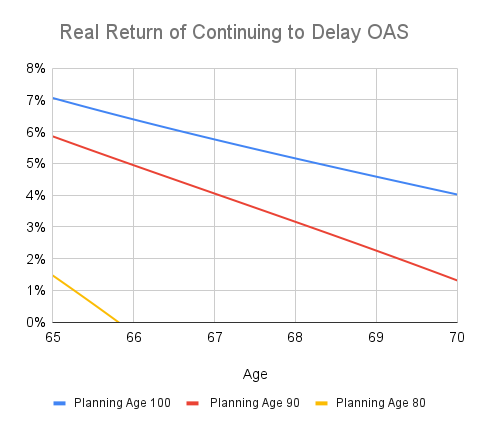
Canadians who collect Old Age Security (OAS) now get a 10% increase in benefits when they reach age 75.  The amount of the increase isn’t huge, but it’s better than nothing.  A side effect of this increase is that it makes delaying OAS benefits past age 65 a little more compelling. The standard age for starting OAS benefits is 65, but you can delay them for up to 5 years in return for a 0.6% increase in benefits for each month you delay.  So, the maximum increase is 36% if you take OAS at 70. A strategy some retirees use when it comes to the Canada Pension Plan (CPP) and OAS is to take them as early as possible and invest the money.  They hope to outperform the CPP and OAS increases they would get if they delayed starting their benefits.  In a previous post I looked at how well their investments would have to perform for this strategy to win .  Here I update the OAS analysis to take into account the 10% OAS increase at age 75. This analysis is only relevant...

<< Previous Post Next Post >>

Giving with a Warm Hand

I expect to be leaving an inheritance to my sons, and I’d rather give them some of it while I’m alive instead of waiting until after both my wife and I have passed away.  As the expression goes, I’d like to give some of the money with a warm hand instead of a cold one. I have no intention of sacrificing my own retirement happiness by giving away too much, but the roaring bull market since I retired in mid-2017 has made some giving possible.  Back then I thought stock prices were somewhat elevated, and I included a market decline in my investment projections to protect against adverse sequence-of-returns risk. Happily for me, a large market decline never happened.  In fact, the markets kept roaring for the most part.  As it turned out, I could have retired a few years earlier.  A large market decline in the near future is still one of several possibilities, but the gap between our spending and the money available is now large enough that we are quite safe.  ...

<< Previous Post Next Post >>

Short Takes: Rental Real Estate, Example TFSA Uses, and more

I’ve lost count of the number of real estate agents and mortgage brokers in Canada and the U.S. who’ve told me that right now is a fantastic time to buy a rental property.  Usually, they don’t own any rental properties themselves and have no plans to buy one now, but they’re sure that it would be a great time for me to buy. When I say that I’m not interested in using my capital to buy the part-time job of being a landlord, they tell me to hire a management company.  When I tell them I’ve heard from landlords that management companies soak up most or all of the profit from being a landlord, they usually give up on me. I guess my message here is that I’ve found a fairly short path to ending an uninvited sales pitch about real estate.  You’re welcome. Here are some short takes and some weekend reading: Robb Engen shows that TFSAs can be very useful for smoothing out life’s financial bumps without creating a big tax bill.  This gives you time for the necessary next step...

<< Previous Post Next Post >>

Short Takes: Behavioural Economics, Monty Hall, and more

I find behavioural economics and other aspects of psychology interesting, but I often get lost between a study’s results and the conclusions people draw from these results.  A good example is the oft-repeated fact that most people believe they are above-average drivers.  I have no doubt that a large majority of people will consistently report that they are above-average drivers.  However, the tidy conclusion that these people are overconfident isn’t obvious to me. There is no single measure of the quality of a driver.  Imagine two brothers where one believes that it is crucial to observe the speed limit at all times, and the other believes it is prudent to always stay up with the flow of traffic to minimize relative speeds.  These standards of driving skill are in conflict, and each brother judges the other to be a poor driver.  Each brother believes he is the better driver based in part on his view of what makes a driver good. It may be that both brothers ...

<< Previous Post Next Post >>

Short Takes: Podcasts, 2022 Returns, and more

I haven’t had many people ask me whether I’d consider hosting a podcast, but it’s come up enough to make me think about it.  I have some solid reasons for not doing a podcast: it’s way more work than I’m willing to do, and my voice isn’t good.  To illustrate the best reason, though, consider this hypothetical exchange: MJ : Welcome to the podcast, Dr. G. Guest : I’m happy to be here. MJ : Let’s get right to it.  Please describe your research interests. Guest : I work on retirement decumulation strategies, safe withdrawal rates, and risk levels of equities. MJ : From what data do you draw your conclusions? Guest : I use worldwide historical returns of stocks and bonds. MJ : How do you deal with the challenge that we don’t have enough historical return data to directly draw statistically significant conclusions? Guest : Uh … I perform simulations drawing from the available pool of data. MJ : So, you create seemingly plausible return histories to extrapolate from the small p...

<< Previous Post Next Post >>

Bullshift

In his book Bullshift: How Optimism Bias Threatens Your Finances , Certified Financial Planner and portfolio manager John De Goey makes a strong case that investors and their advisors have a bias for optimistic return expectations that leads them to take on too much risk.  However, his conviction that we are headed into a prolonged bear market shows similar overconfidence in the other direction.  Readers would do well to recognize that actual results could be anywhere between these extremes and plan accordingly. Problems in the financial advice industry The following examples of De Goey’s criticism of the financial advice industry are spot-on. “Investors often accept the advice of their advisers not because the logic put forward is so compelling but because it is based on a viewpoint that everyone seems to prefer. People simply want happy explanations to be true and are more likely to act if they buy into the happy ending being promised.”  We prefer to work with those who...

<< Previous Post Next Post >>

Archive

Show more