Posts

Get new posts by email:
  

George Soros: Hero for the Active Investor

There is ample evidence that the average active investor gets lower returns than passive investors, but that doesn’t preclude a minority of active investors from outperforming passive indexes. The great investor and hedge fund manager, George Soros, serves as a hero for the active investor who dreams of outsmarting the market. In his book Soros: The World’s Most Influential Investor , Robert Slater looks at Soros’s life, investing record, philanthropy, and politics. Soros is best known for his 1992 bet against the British pound when the Bank of England was forced to abandon the exchange rate mechanism designed to keep currency values within certain ranges. Soros made about a billion dollars in this high-stakes gamble against the pound and another billion dollars in simultaneous bets on other currencies. Some viewed Soros’s actions as stealing from the British people, but Soros sees himself as a “critic” of financial markets who backs his opinions about the value of stocks and cu...

<< Previous Post Next Post >>

Understanding Ontario’s Switch to the HST

Ontario’s 2009 budget included a switch from a retail sales tax separate from the GST to a harmonized sales tax (HST). Superficially, this may seem like a trivial change because the retail sales tax was 8% and the provincial portion of the HST will also be 8%. However, there are two main differences that will affect Ontarians. The first difference is known to most people: the HST will apply to more goods and services than the retail sales tax does. The main change is that services will now be taxed at the 13% HST rate rather than just the 5% GST rate. If this were the only change, then it would represent a substantial tax hike. But, there is another less well understood difference that changes the equation. Businesses can now use input tax credits (ITCs) for the HST. A business that collects HST from its customers doesn’t have to give all this money to the government. The business deducts the HST paid on the products and services it purchases to run its commercial operation...

<< Previous Post Next Post >>

Help Wanted – Male

Image
This is a Sunday feature looking back at selected articles from the early days of this blog before readership had ramped up. Enjoy. I was rooting through my father’s old papers from a time when he was looking for work and came across the following ad that appeared in the July 31, 1964 Montreal Star: I was struck by the obvious sexism and ageism: must be a male between 25 and 35 years old. The point is not to call out this newspaper or the company placing the ad, but to realize that this was an accepted common practice at the time. Slow change can creep up unnoticed, but it’s obvious that the world has changed quite a bit (for the better) since this ad was placed.

<< Previous Post Next Post >>

Short Takes: Retirement Crisis and Tax Software

1. John Bogle, founder of the Vanguard Group, testified before the U.S. House of Representatives about the coming retirement crisis. Bogle makes many strong points about failings of our financial system that threaten retirement. An additional point I’d make is that with people living longer and the retirement age remaining fixed, we are spending in increasing proportion of our lifetimes retired. This seems unsustainable. If life expectancy increases, maybe the retirement age has to increase as well. 2. Canadian Financial DIY rated web tax preparation software . TaxChopper investigated the inconsistent results among different tax packages, and gave a detailed response . 3. Canadian Money Review reports being charged for overpaying a Sears bill! (the web page with this article has disappeared since the time of writing). This is the first I’ve heard of this one. The few times I’ve forgotten to pay a credit card bill on time, I made a big overpayment to avoid ongoing interest c...

<< Previous Post Next Post >>

Direct Energy Viewed as an Insurance Company

Direct Energy is well-known for its flat-rate natural gas plans. By guaranteeing rates for a period of time, they are in effect acting as an insurance company. Any time you buy insurance, you need to find out if the other party is financially sound enough to follow through on its promises. According to Direct Energy, they currently offer a two-year flat rate natural gas plan in my area at a rate that is about 30% higher than the variable rate that I’m paying right now. This added 30% amounts to a premium for 2 years of insurance against rate hikes. But what happens if natural gas supplies are interrupted and rates spike up? Will Direct Energy be able to fulfill its promises if variable rates double? I have no idea, but anyone considering entering into a flat rate plan should find out. If Direct Energy isn’t able to maintain promised rates, customers could end up paying the flat-rate premium and then paying the high variable rates too. Any time we enter into agreements with ...

<< Previous Post Next Post >>

Market Timer Breakeven Date

Image
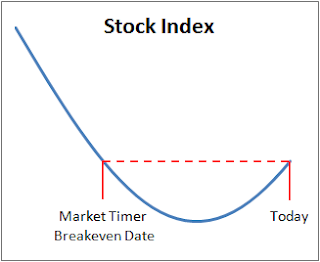
Market timers often jump out of the stock market when they think it is going down in the hopes of getting back in at lower prices. For this to work, the investor has to get out early enough and back in early enough to avoid selling low and buying high. This brings us to the idea of a “market timer breakeven date.” The following picture illustrates what I mean. Let’s assume for the moment that stocks are now on the rise. A market timer getting back into the market today would have to have sold out of the market before the breakeven date shown in the picture to come out ahead. Any given day we can draw a line over to see the new breakeven date. As stocks rise, the breakeven date moves further into the past sweeping by the exit dates of investors who haven’t jumped back in yet making them losers in the market timing game. Of course, the stock market doesn’t move in a nice smooth curve like the one shown. It jumps up and down mostly unpredictably. Looking at the chart of the TSX, the...

<< Previous Post Next Post >>

Winning the Lottery

We’ve all heard that lotteries are a sucker’s game, and this is mostly true. Taking Canada’s Lotto 6/49 as an example, only 47% of the money spent on tickets gets repaid in prizes. So, players pay $2 for a ticket worth only 94 cents. However, there is a way to stack the odds in your favour if you have the right information. There are any number of books and web sites touting systems for picking lottery numbers based on which numbers have been drawn more or less frequently in past draws. None of these work. My system of playing the 6/49 actually has a long-term expectation of profit. To understand this system, we need to start with a little information about how the 6/49 works. Each player chooses any 6 of the numbers from 1 to 49 and pays $2 for this combination. There are just under 14 million combinations available. The draw consists of 6 numbers plus a bonus seventh number. The player gets prizes if his combination matches 3 or more of the drawn numbers. The more matches, ...

<< Previous Post Next Post >>

Archive

Show more